


.png)



paź
27,
2026
The traditional speedlight—though powerful and indispensable for wedding or event photography—can be quite a burden. Its large size, the need to ...


foto - tip | more than passion
paź
27,
2026
The traditional speedlight—though powerful and indispensable for wedding or event photography—can be quite a burden. Its large size, the need to ...
wrz
15,
2026
There are flash lights you buy for a single task. And then there are those that, over time, begin to play several different roles. Flash lights ...
lip
24,
2026
The launch of the DJI Osmo Pocket 4 opens up new possibilities for video creators. Discover how Irix Edge filters elevate the quality of your ...
cze
09,
2026
Godox V1 MID is a compact round-head TTL flash with HSS, USB-C battery charging and a 2.4 GHz wireless radio system. See who it is best suited for.
sty
13,
2026
Learn how to capture the emotion and speed of drift events: essential gear, lighting techniques and practical tips for creating powerful ...
gru
29,
2025
What is HSS and why does it allow flash photography with very fast shutter speeds? Learn why black bands appear in photos, how High Speed Sync ...
gru
17,
2025
Learn how to properly edit RAW files to bring out details, set a natural white balance, and give your photos consistent, fresh colours. Simple ...
gru
10,
2025
A Christmas photo session is a wonderful way to capture the magic of the holiday season. Discover how to create warm, natural and emotional photos ...
gru
05,
2025
Learn the essential principles of landscape composition. Discover how to use the rule of thirds, leading lines, natural frames and symmetry to ...
lis
28,
2025
Discover how to capture stunning photos during the golden and blue hours. Learn to plan light, use the best settings, and shoot in perfect natural ...
lis
03,
2025
Minimalism in landscape photography is about stripping the image down to its essence -using light, space and composition to create calm, powerful ...
paź
31,
2025
Shoot with intention - discover tools that help you plan the perfect outdoor session. This guide offers practical tips on maps, weather and ...
paź
30,
2025
Long exposure photography reveals motion in a magical way – from silky smooth water to clouds drifting across the sky. Learn step by step how to ...
paź
16,
2025
Landscape photography is more than just beautiful views. It is the art of capturing light, emotion, and the fleeting moments of nature. Discover ...
sie
11,
2025
Learn the safest ways to clean your camera’s sensor – and how to know when it’s time to let a professional handle the job.
lip
16,
2025
Award-winning, creator-approved – 11 standout products that combine innovation, reliability, and the joy of great photography.
maj
27,
2025
Dive into the captivating world of storm and lightning photography, where the right preparation and techniques will help you capture the majesty ...
maj
05,
2025
Discover the top 20 best-selling products of Q1 2025 – from lighting to accessories, here’s what photographers all over Europe loved most.
kwi
10,
2025
What happens when a macro lens meets the open landscape? The Irix 150mm f/2.8 brings a fresh perspective with reach, clarity, and compression.

The rapid technological development of photography over the last few decades has significantly expanded what photographers can achieve with flash lighting. Modern cameras and flash units offer many useful features, including automatic exposure modes, precise autofocus systems and wireless control of lighting setups. One of the most important features is HSS (High Speed Sync), meaning flash synchronization with very short shutter speeds. Speedlights as well as studio flash lights that support this mode make it possible to achieve results that cannot be obtained using standard flash synchronization.
Choosing the correct shutter speed is often challenging for photographers who are just starting to work with flash. Common questions include: “Why can’t I use a shutter speed of 1/800 s with flash?” or “Why do black bands appear in my photos?”. Below, we explain what causes these issues and how High Speed Sync solves them.

Diagram of a focal-plane shutter – when shutter speeds shorter than X-Sync are used, the shutter appears as a black band in the image. When photographing with an on-camera flash, you may see a situation where only part of the frame is properly exposed while the rest is darker. This is not caused by a faulty flash, but by the design of the camera’s focal-plane shutter, which is used in most modern cameras. Because of how this shutter works, flash can be used only within a limited range of shutter speeds. The shortest usable value, depending on the camera model, typically falls between 1/160 s and 1/320 s. This limit is called X-Sync, the fastest shutter speed at which the entire sensor is exposed at the same time.
You can find your camera’s X-Sync in the specifications or check it with a simple test. Set about 1/150 s and shorten the shutter speed step by step. Once dark areas start to appear in the image, you have exceeded the sync limit.

HSS (High Speed Sync) allows flash synchronization at shutter speeds shorter than the X-Sync limit. Instead of firing a single flash burst, the flash unit emits a rapid series of ultra-short pulses that evenly illuminate the sensor as the shutter travels across it. The biggest advantage of HSS is greater freedom when balancing flash and ambient light. In bright conditions you can use a very fast shutter speed to reduce ambient exposure while still shooting with a wide aperture for shallow depth of field. To use HSS, both the camera and the flash unit must support the mode. When working off-camera, a compatible flash trigger that supports High Speed Sync is also required.
Keep in mind that HSS reduces effective flash output. For shooting in full sunlight, higher-power units or setups using multiple lights often deliver the best results.
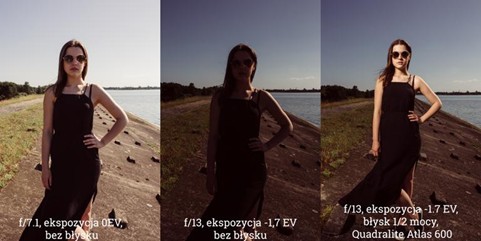
Freezing motion is often associated with very fast shutter speeds, but in practice HSS is not always the best option for dynamic subjects. Because flash power is reduced in HSS, it may be harder to light fast action effectively. In many cases, a more effective approach is using manual flash with a very short flash duration. A short flash burst can freeze motion reliably even when the camera shutter speed is not extremely fast.
Every flash has a specific flash duration, and it strongly affects image sharpness, especially with moving subjects. Parameters such as t0.1 and t0.5 describe how long the flash emits light during a single discharge.
In practice, t0.1 is the more meaningful value because it reflects the real, usable length of the flash pulse more accurately. The shorter the flash duration, the higher the chance of capturing moving objects with clean, sharp edges. It is important to distinguish between flash sync speed and flash duration. Sync speed determines which shutter speeds can be used with flash, while flash duration is what actually freezes motion.

Speedlights may not provide enough power in full sun, while traditional studio lights require mains electricity. In these situations, battery-powered outdoor flashes are an excellent solution. They combine strong output with mobility, making it possible to work almost anywhere. This is especially useful for outdoor portraits and location shoots in bright ambient light.
When paired with HSS, battery flashes let you light the subject and reduce sunlight using fast shutter speeds, without sacrificing exposure control or depth of field.
Although High Speed Sync may seem complex at first, it quickly becomes intuitive in real-world use. HSS enables fast shutter speeds, better ambient light control and more creative depth of field options.
If you want to work confidently with flash in a wide range of lighting conditions and maintain strong control over exposure, a flash system with HSS support can become one of the most valuable tools in your kit. Do you use HSS in your photography? Share your experience in the comments.


Comments : 1